This presentation displays some Highlights that my classmate and I, found really amazing during the Grand Final of the Rugby World Cup 2015. I collaborated on this with Yvette.
Showing posts with label Yvette. Show all posts
Showing posts with label Yvette. Show all posts
Friday, 6 November 2015

Thursday, 15 October 2015
Shake Out!
This is my presentation that I collaborated on with a classmate. We participated in the New Zealand Earthquake Drill, Shake out! This DLO contains information about what we did and more information about the Shake out.
Tuesday, 13 October 2015
The Grid Challenge


This is a few pictures from the Grid Challenge that we tried out this morning. We had to get into pairs and grab a pencil. Each pair was given one paper. The paper displayed a large grid that had a clear line down the middle. This line showed the separation from each partners grid. We were also given two dice. Each time we rolled the dice, we used the numbers to look for arrays on our grid. The aim of the game was to fill out our grid as much as possible. When the time was up, we counted the left over squares of the grid. My partner Yvette had 8 squares left and I had 6. That meant I won because I had the least squares left over. I think that this game is very useful for when practising arrays or multiplication. The Grid Challenge was a lot of fun to play, and a really interesting way to learn maths.
Friday, 5 June 2015
How the Eye works
This is my Homework poster. We learnt about how the eye works. I completed this with a classmate. I think we were very detailed in our writing and chose a good colour scheme.
Friday, 27 March 2015
Malama Honua
This is a DLO that retells our experience of welcoming the Hokule'a waka. I worked on this DLO with 2 other classmates. It was a collaborative task and achievement. Hopefully you can learn something from it!
Tuesday, 10 March 2015
Powtoon DLO Strategy
Here is a collabrative slide show by Sajiha, Yvette and I. We have used Powtoon to create a video/slideshow to show our learning with decimals. Our learning intention is to: solve addition problems with tenths by changing one number into a whole number. If you would like to use Powtoon, you can have a try using this link: https://www.powtoon.com/
Thursday, 30 October 2014
Phases of the moon
This is a presentation a few of the students in Room 9 created. It explains the phases of the moon in a simple way that is understandable to most audiences.
Why are stars not visible during daytime?
Have you ever wondered why stars aren't visible during daytime? Majority of people believe that stars have disappeared as the sunset rises, but stars are still there, just hiding. Stars are hidden behind the bright blue rays that are received from the Sun.
Stars are luminous points in the night sky. They are produced when a nebulae (spinning tornado of gases, dust and cloud) creates a ball of helium and hydrogen. Soon, this sphere flames up and creates a star. When the helium and hydrogen gases interact with each other, they form an explosion or scientifically known as a ‘Nuclear fusion’. The more nuclear reactions that occur on this star, the brighter the star becomes.
As the Earth is spinning on its own axis, it absorbs darkness from the moon and light from the Sun. This is because one side of the Earth is facing the bright light from the Sun, while the other is facing the dark moon. It’s like when a person is facing the light, and the back of their body is dark. This creates the illusion of day and night. Due to the Suns bright blue light, we are not able to see the stars that are actually still there. Luckily as night falls, the stars shine brightly and are visible to the human naked eye.
Isn't it amazing how we aren't able to see stars at daytime, when they’re actually still there? Inside the storage of many minds, you will not discover information about why we aren't able to see stars in sunlight. The world of astronomy may be big, but its a triumph to know we both have learnt just a small amount of knowledge about it.
This is an explanation that a classmate and I wrote together. It explains the illusion of stars disappearing during daytime.
Thursday, 16 October 2014
Solar System Paragraph
The Solar System is apart of the galaxy usually known as ‘The Universe’. The Solar System consists of eight planets, and more than a quadrillion amount of stars. In ancient times, people began to create constellations with the stars. Most people say that they’re able to probe the stars but do they realise stars are light years away from us, somewhere floating in lost gravity? Light Years away, Earth is spinning on its on axis. This process produces an illusion of day and night: One side of the Earth absorbs light from the Sun, while the other side absorbs darkness. Because of the nuclear fusions happening inside the Sun, day is caused when bright blue Sun rays hit Earth’s atmosphere, hiding stars from the naked human eyes. Astronauts who travel to space are trained so they’re able to help expand knowledge in space explorations and technology. We believe, that our solar system is unique.
Above is a paragraph that includes information about the Solar System, and what it consists of. The whole class were split into 5 groups. Mrs Anderson wrote over 10 words onto the whiteboard. Each group had to include these words into their paragraph. The people listed below are the students who produced this paragraph:
Fine, Yvette, Pah Nwee and Tui.
Fine, Yvette, Pah Nwee and Tui.
Friday, 29 November 2013
My Drama Blog Post

This is my drama blog post. For drama we had to become things of water. We had to act out the things that Mrs Eeles told us to become. We had to become groups of four. My group was Jharda'e, Yvette & Tim.
Thursday, 4 April 2013
Dance.
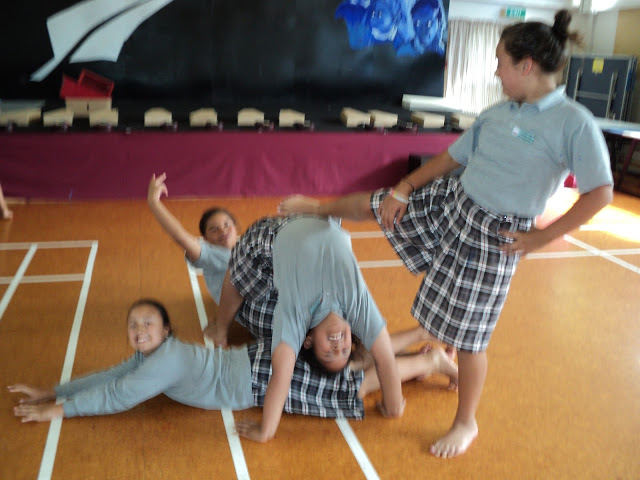
This is what room 5 did for dance this week. We all were given a letter. Angel was A, I was B , Caitlin was C and Yvette was D. A (Angel) had to do an open pose then B (me) had to go through, under or around and it kept on going.
Subscribe to:
Posts (Atom)